Up to 50 years ago...
...the Eel was considered one of the few pristine rivers left on Earth. It was
a world-famous sport fishing river, major contributor to commercial ocean fishing,
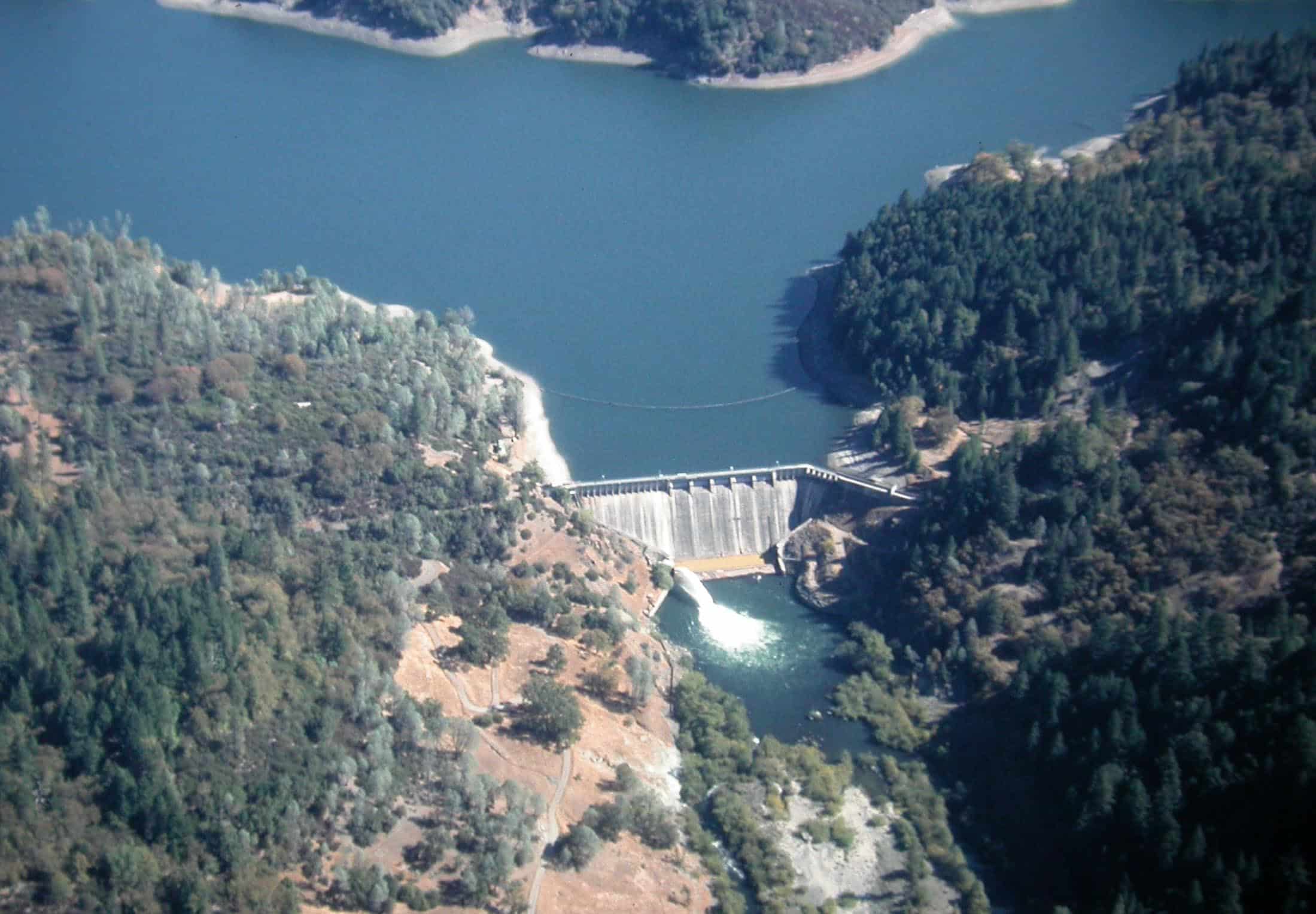
and home to the now almost-extinct sturgeon and eels (lamprey). The PG&E Potter
Valley Project (PVP) has helped change all that.
Designated Reach: National Wild & Scenic status was
given on January 19, 1981. From the mouth of the river to 100 yards below Van
Arsdale Dam. The Middle Fork from its confluence with the main stem to the southern
boundary of the Yolla Bolly Wilderness Area. The South Fork from its confluence
with the main stem to the Section Four Creek confluence. The North Fork from
its confluence with the main stem to Old Gilman Ranch. The Van Duzen River from
the confluence with the Eel River to Dinsmure Bridge.
Three forks of the Eel contain a diversity of river types
originating in high mountain pine forests, flowing through steep canyons and
coastal redwood forests, and emptying into the Pacific in a gently sloping valley
with virgin redwood stands. It is joined in the coastal plain by the designated
Van Duzen that, along with the Eel, is noted for its salmon and steelhead. From the National Wild and Scenic Rivers System
1904: Local residence of Ukiah decided that the city's small coal operated plant(which
caused air quality problems) did not meet the growing power needs.
1905: W.W. Van Arsdale formed the Eel River Power and Irrigation Co. for the purposes
of constructing the hydroelectric plant. The Ukiah city council hired Mr. Van
Arsdale under contract to supply power to the city, and the construction of
the diversion tunnel from the Eel River to the Russian River began.
1908:
The original power company reorganized into the Snow Mountain Water and Power
Company, and completed the diversionary tunnel and Cape Horn Dam/Van Arsdale
Reservoir on the mainstem Eel River. This tunnel contributed throughout the
years to the devastation of the river's namesake. Swept up with the water, eels
were crushed to death by the turbines, occasionally stopping power generation
and causing the water to back up. After the diversion, eels also swarmed up
the Russian River. "The engineers saw they would have to be eliminated, and
hit upon the novel method of electrocuting the slim and slippery fish. A number
of wires were strung among the eels, a high-voltage current turned on, and several
wagon loads of dead eels hauled away" (Popular Mechanics, January 1914, p. 69).
This first effort to provide electricity to the city of Ukiah proved to
be quite successful, as it generated enough electricity(4,000 kW.) for several
blocks downtown. Since the small but growing city had been relying on coal-burning
generators for light, citizens were happy to have clean air again. However,
the city fathers were unaware and when educated still did not care that this
diversion of Eel River water to the Russian River would have such a profound
effect on the entire river system and its corresponding wildlife.
1920: Silting in Arsdale Reservoir prompted the Snow Mountain and Power Company
to apply to the U.S. Forest Service for a final power permit for the construction
of Scott Dam. Construction of the dam began that same year and a request was
made to transfer the final application for the final power permit to the Federal
Power Commission.
1921:
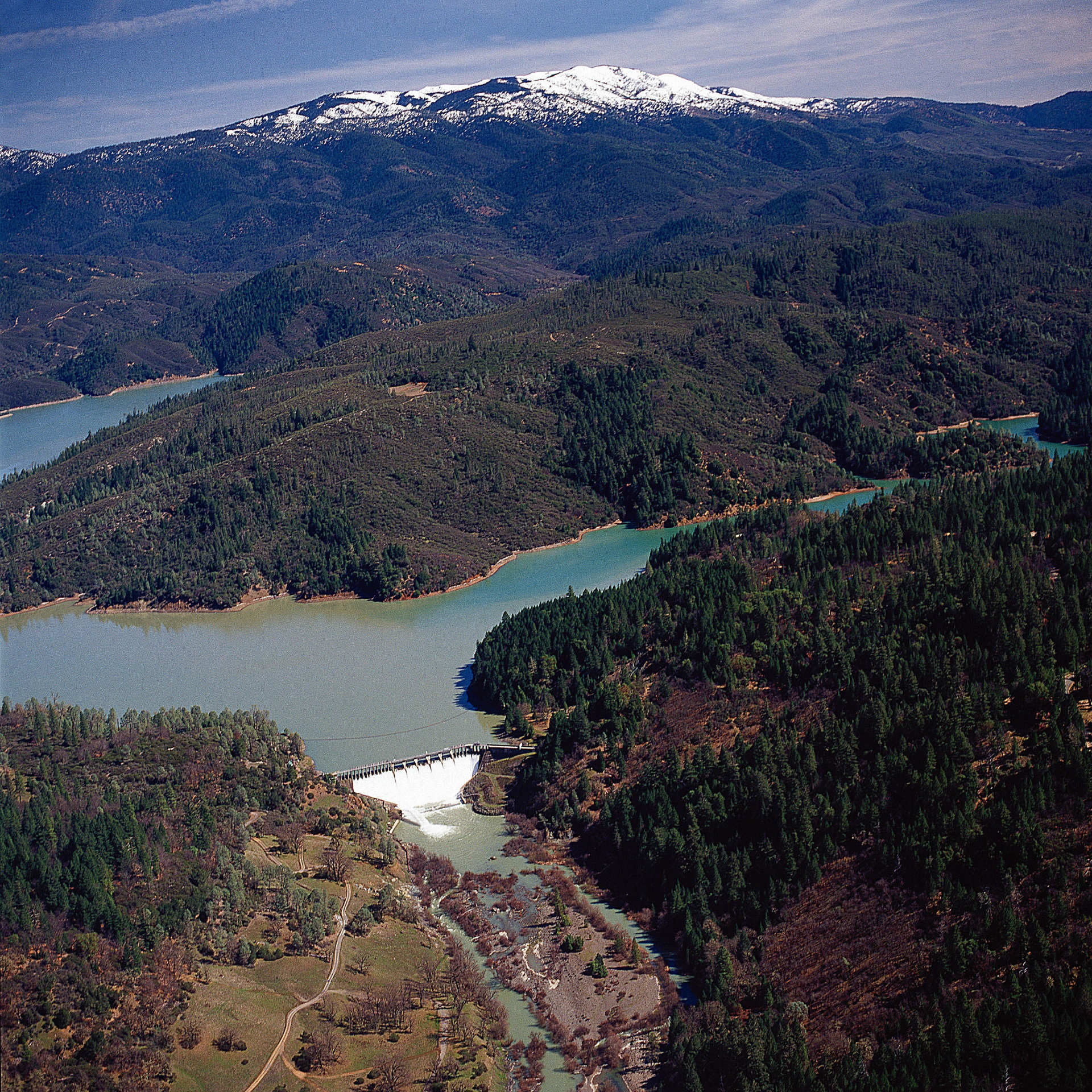
Scott Dam is built twelve miles upstream of the Van Arsdale diversion, creating
Lake Pillsbury as an even larger reservoir for the PVP. As much as 90% of the
lake's water is shunted through to the Russian River, clear on down to the Marin
County water system.
1922: The Federal Power Commission issued a 50 year license for the PVP. As a
condition of that license, there was a minimum release of 2 cubic feet per second
required to be released down the Eel River to satisfy existing water rights.
Humboldt County takes legal action to stop this diversion because of its detrimental
impacts on the Eel River, but is told that business interests and progress are
more important than fish.
1924: Potter Valley Irrigation District formed.
1926: Potter Valley Irrigation District began using water.
1930: Pacific Gas and Electric Company(PG&E) acquired the lands, facilities
and accompanying Eel River Water Rights. The 50 year license issued to the Snow
Mountain Water and Power Company was transferred to PG&E.
1950:
Diversion tunnel enlarged to the present capacity of 345 cubic feet per second
(cfs).
1959:
The Corp. of engineers constructed the Coyote Dam on the Russian River, creating
Lake Mendocino.
1967: Construction began on Warm Springs Dam.
1970:
PG&E filed for a renewal of the PVP license.
1972:
The original license expired April,14th and an annual license was issued to
PG&E.
Humboldt County Supervisor Ray Peart conducted a field investigation of the
PVP and reports that the minimum flow of 2 cfs allocated to the Eel River may
be having adverse impacts on its fisheries.
1974:
Construction on Warm Springs Dam halted over concern for project safety and
effect on environment, primarily archeological sites. Study undertaken to examine
cultural resources in the valley.
1975:
The PVP comes up for relicensing by the Federal Energy Regulatory Commission
(FERC). Humboldt County, along with major fishing organizations, argues for
more water to be released into the Eel River instead of being diverted south.
The county spends $1 million on this effort.
1978:
PG&E prepared an EIS on the PVP. Supervisors from Humboldt, Mendocino, Sonoma
and Lake counties formed the Eel -Russian River Commission to investigate modifying
flow agreements. Meetings are conducted with DF&G, PG&E, Sonoma County
Water Agency (SCWA) and the Department of Water Resources (DoWR) thru 1983.
1983:
No fishing organizations joined the Department of Fish and Game, PG&E, SCWA,
and County Supervisors to sign an agreement that increases the flow to a mere
5 cfs in conflict with fish studies indicating that at least 45 cfs are needed
to support the fishery. Nevertheless, FERC grants a 50-year license to PG&E,
which includes Articles 38 & 39 requiring a 10-year study to determine the effects
of the new flow schedule and a new flow recommendation. It is this study and
its a subsequent public hearing that is the window through which this devastating
diversion will be stopped. Meanwhile, on a tributary (Dry Creek) to the Russian
River, Warm Springs Dam is built for the Sonoma water supply. When the Sonoma
County Water Agency applies for more water allocations from the Russian River,
the State Water Resources Control Board consistently asks what back-up plans
the agency has if the Eel River diversion is stopped. According to state records,
the agency always replies that it will rely upon the water in Lake Sonoma if
it were to lose the Eel River water. Yet currently SCWA is applying for 92%
of all its water allocations in Lake Sonoma, thereby removing a water source
to make up Eel River losses when the diversion is stopped. This is one of the
grounds for our current legal action against the agency.
1987:
PG&E completed modifications of the existing fish ladder.
1993:
The state orders PG&E to conduct seismic reinforcement of Scott Dam by 1997.
1994:
Department of Fish and Game's illogical claim that "the Eel River is dead" spurs
the formation of FOER. A window in time is discovered for dam decommissioning,
as the California electrical industry is being deregulated, the PVP is likely
to be sold, and the FERC hearings on Articles 38 & 39 proceed. SCWA goes public
with its desire to control the Eel River water. Behind the scenes in D.C., politicians
try and fail to pass a bill to achieve this.
1995:
Friends of the Eel Rivers (FOER) filed as an Intervener in the Federal
Energy Regulatory Commission (FERC) proceedings, forcing the agency to reassess
its Draft Environmental Impact Statement on Pacific Gas & Electrics
Potter Valley Project (PVP). This decision continues FOERs goal of decommissioning
the Potter Valley Project and its dams as a viable alternative for the Commission.
1996: Marin County gives Sonoma County its first payment of $5 million to join
forces in purchasing the PVP. The power-generating monopoly is deregulated,
and the PVP sale goes on hold as PG&E repositions itself.
1997:
Scott Dam is determined by the state to no longer need systemic retrofitting
since PG&E scientists said the dams were "adequate." The coho salmon is listed
under the federal Endangered Species Act (ESA) but not under the California
ESA.
1998:
Sixteen years of waiting end with the completion of PG&E's study on the effects
of increasing the trickle to the Eel River from 2 cfs to 5 to 10 cfs. FERC responds
to staff assertions that flow recommendations constitute a significant enough
change in PVP operations to necessitate an EIS. This decision allowed FOER to
become Interveners in the FERC/PG&E process and to request that decommissioning
be considered. PG&E announces in a filing with the California Public Utilities
Commission that it does not intend to retain its hydroelectric generation assets
in the deregulation of the power monopoly. More than 2,500 signatures petitioning
FERC to decommission the PVP are handed in at each public meeting. (By the year
2000, more than 20,000 signatures were collected, and the effort continues.)
FOER Board is formalized and 501(c)3 status granted.
1999:
January 8, 1999: FOERs intervention in the California Public Utilities
Commission (CPUC) hearings prompted the formation of a statewide coalition focused
on halting the auction of PG&E facilities on the grounds that their Environmental
Impact Statements (EIS) failed to address and rectify massive environmental
degradation, including the virtual extinction of endangered salmonid stocks,
throughout the mountainous regions of Northern California. Specific to our mission,
FOER argued that PG&Es diminution of water flows virtually annihilated
the Eel Rivers historic runs of tens of thousands of Chinook and Coho
salmon and steelhead trout and severely compromised Humboldt Countys
commercial and sport fishing industry to the tune of $10 million annually,
and over $8 billion cumulatively since construction of Cape Horn dam in 1908.
January 14, 1999: FOER filed suit against Sonoma County
Water Agency (SCWA) challenging their Water Supply Transmission System Project
(WSTSP) which proposed to increase both the annual and maximum rate of water
diversion from the Russian River. This increase depended on taking 92% of SCWAs
allocation from Lake Sonoma, thereby removing the water source promised to replace
Eel River water when the PVP diversion ended. The lawsuit challenged the increased
diversions under CEQA, the California Planning and Zoning Law, Water Rights
Law regarding consumptive purposes by one watershed from another, and Public
Trust Doctrine.
April 2, 1999: FOER intervened in FERC proceedings regarding
re-licensing of PG&Es Potter Valley Project and provided oral argument,
as well as written and live testimony from expert witnesses, thus documenting
the impact of PG&Es water diversion. FERC has not yet rendered a final
decision.
November 29, 1999: FOER moved to intervene in opposition
to PG&Es resubmission of its application to CPUC to auction off its
hydroelectric facilities. We countered with legal argument and testimony from
expert witnesses. CPUC ruled that a full EIR was required on PG&Es
divestiture; the initial proposal to auction off its facilities was rejected.
Before the CPUC could take action on PG&Es alternative proposal to
transfer its hydroelectric assets by sale, the California Legislature adopted
special legislation in early 2000, forbidding the company from transferring
its hydroelectric assets until 2006. Though this leaves FOER in a holding pattern,
it is prohibitive in terms of PG&E making any sudden moves.
2000: February 4, 2000: CPUC rules in favor of our motion, asking that PG&E
do an EIR on all projects, including the PVP, before any can be sold.
February 17, 2000: The State Supreme Court upholds the
recent publishing of the ruling in the El Dorado Irrigation District case. This
decision, now law, means that any FERC-licensed hydro project must comply with
the California Environmental Quality Act (CEQA), as well as county and local
general plans.
September 12, 2000: FOER filed protest at the State Water Resources Control
Board against Sonoma County Water Agencys application to appropriate water
and petitions requesting changes and extensions in water rights permits regarding
their Water Supply Transmission System Project. Our arguments focused on the
projects numerous violations of the California Water Code, prior State
Water Resources Control Board decisions, the California Environmental Quality
Act (CEQA), and Public Trust Doctrine. (note: to date 7/2003 SCWA has failed
to respond, so this issue is currently moot)
2001:
With the bankruptcy filing by PG&E all legal actions are on hold for most of
the year. FERC indicates that it will go with a proposal for fishery flows developed
by the fox watching the hen house. A great public outcry causes FERC to tell
the National Marine Fisheries Service to stop its "Biological Opinion" assessment
of the Potter Valley Irrigation District plan since this plan has not had public
input or scrutiny. FERC has not even followed its own procedural process.
2002 January 22, 2002: FOER intervened in PG& Es Bankruptcy proceedings
regarding the proposal to dispose of its hydroelectric assets, and on February
22nd Dennis Montali, the United States Bankruptcy Judge, approved our intervention,
thus authorizing FOER to participate in the bankruptcy proceedings. We are involved
in the process and file additional papers as necessary to protect watershed
interests.
February 7, 2002: FOER intervened in PG&Es
filing to FERC for the approval of the transfer of its licenses to 27 new limited
liability corporations. These applications affected 37 projects and 27 watersheds.
PG&Es plan to reorganize under Chapter 11 Bankruptcy was challenged
by FOER. Our intervention papers opposed PG&Es proposed transfer on
the grounds that it would fragment integrated watershed management, sidestep
PG&Es applications, and place greater economic pressure on PG&Es
applications. Though PG&E amended the applications to reduce the fragmentation
to which we had objected their applications have remained unacceptable. We are
also using this intervention process to make sure PG&E pays for restoration
costs for the ecosystems damaged by their projects and does not evade state
and environmental laws through sales of power generating projects.
2003:
May 16, 2003: Victory! The First District Court of Appeals issued three primary
rulings under the California Environmental Quality Act (CEQA) in favor of Friends
of the Eel Rivers appeal against the Sonoma County Water Agency, setting
legal precedent binding on Superior courts throughout the State of California.
The EIR on the Sonoma County Water Agencys WSTSP
is deficient. It does not address the dire condition of the Eel Rivers
fisheries resulting from the water diversions upon which the project
depends.
SCWA failed to consider the cumulative impact of the
diversions of Eel River water into the Russian River. FOER argued that
SCWA gave conflicting reports to FERC in its objection to curtailment
in the existing level of water diversions from the Eel River while maintaining,
in its own reports that adequate water exists for the diversion project.
SCWA cannot have it both ways in objecting to curtailment and then stating
there is sufficient water for development.
The Water Agency failed to account for the projects
dependence on Eel River water and did not adequately consider alternatives.